Environmental Considerations
INTEGRATING GREEN BUILDING AND SUSTAINABILITY THROUGHOUT
OUR BUSINESS
Growthpoint has embarked on a journey of sustainable development and operations that is changing the
way we do business. As a prominent owner and manager of properties in South Africa, we are also growing
our reputation as a pre-eminent green property developer. We do this to better meet the needs of our
clients and ensure the long-term sustainability of our business.
Each sector has different levels of focus within sustainability. So, we have developed a sustainability strategic framework to highlight five key focus
areas for Growthpoint as explained below:
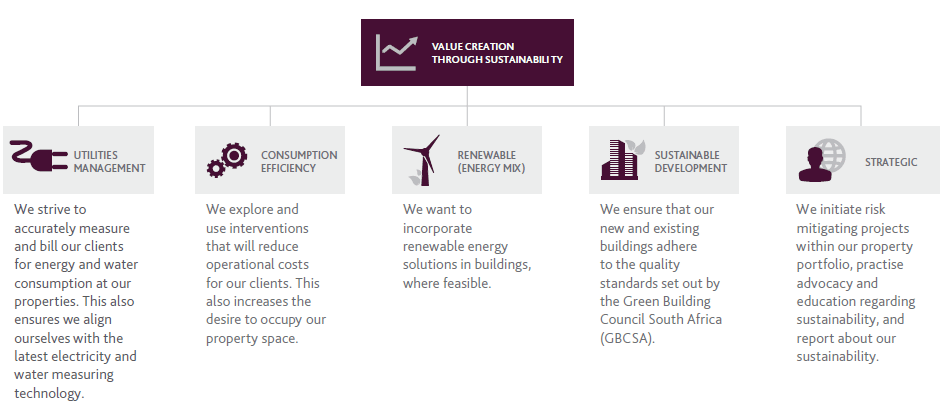
Our sustainability strategic framework leads to identifying interventions of all types and standards. These interventions then flow into a governance
framework. We call this the ‘Six steps to sustainable change’.
The six steps to sustainable change framework ensures that we use a suitable solution with a strong business case, which is aligned to the quality
standards of the GBCSA, where applicable. It also ensures that we track how our interventions perform after implementation.
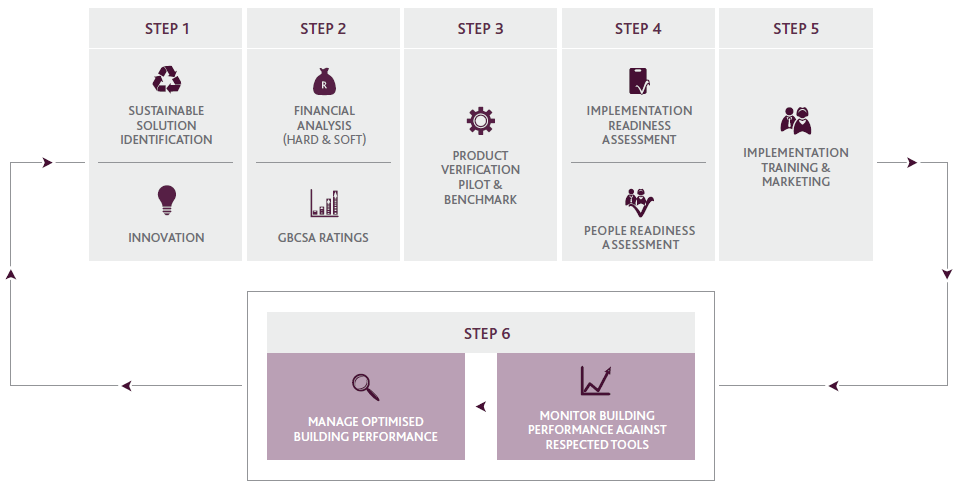
STEP 1
SUSTAINABLE SOLUTION IDENTIFICATION
Sustainable solutions can be identified either within the organisation or
externally. Solutions need to be captured and documented to ensure the
enhancement of organisational learning.
Innovation
Sustainable innovation will become harder to achieve as the GBCSA rating
tools increase in maturity. Identification of innovative solutions within
sustainability would be critical to be successful in the future.
STEP 2
FINANCIAL ANALYSIS
Financial analysis/modelling standards will be developed for all types of
sustainable solutions. Focus needs to be given to both hard financial benefits
(NPV, IRR, etc.) and soft non-financial benefits.
GBCSA ratings
Identified sustainable solutions should align with the GBCSA rating tools.
A strong focus needs to be given to the GBCSA existing building performance
rating tool.
STEP 3
PRODUCT VERIFICATION, PILOT and BENCHMARK
After a solution is deemed to be financially feasible and aligns with the
requirements of the respected GBCSA rating tool, verification and validation
of the solution is required. This can be achieved either by verifying the
products’ specifications at a credible source or by conducting a pilot study
obtaining critical test results. In addition, similar products could also be
benchmarked both financially and technically.
STEP 4
IMPLEMENTATION READINESS ASSESSMENT
Before a product commences the implementation stage (large roll-out)
it needs to go through an implementation readiness assessment. This
will identify key focus areas and areas of concern ensuring a smooth
implementation.
People readiness assessment
It is also important to identify the maturity of key clients to assist in
the prioritisation of implementing a solution.
STEP 5
IMPLEMENTATION TRAINING and MARKETING
The first focus area would be to implement the identified solution.
This would lead to the development of training material for both the
property brokers and the client itself, highlighting the benefits and
operational requirements. Marketing of a single property or property
portfolio should be updated accordingly to ensure that both property
value and rental income increase over time.
STEP 6
MONITOR
| • |
People behavioural change |
| • |
GBCSA EWP tool |
| • |
GBCSA existing building performance rating tool |
| • |
GBCSA design and as-built rating tool |
Manage
| • |
Manage building performance to retain GBCSA rating |
OUR GUIDANCE OR BEST
PRACTICE STANDARDS
Growthpoint uses the Green Star SA rating
system, adopted and adapted by the GBCSA
from the Green Building Council of Australia.
Through local context studies, a rigid peer
review system and expert input, the Green Star
SA tools are thoroughly adapted to respond to
the local market and environment.
The aim of Green Star SA is to provide the
commercial property industry with an
objective measurement for green buildings.
It also recognises and rewards environmental
leadership in the property industry. Each Green
Star SA rating tool is developed in response to
market demand (and sponsorship) and tailored
for different building types and uses.
To support sustainability, and drive it forward,
Growthpoint developed the Property
Management Dashboard. By using this
dashboard tool our staff can access building
information, including sustainability features,
building plans and the lessons we’ve learned
about each of our properties. This ensures that
we maintain and improve the performance of
each building as well as create an organisational
learning culture.
GREEN STAR SA RATINGS
Putting our commitment to green building into
certified action, we have achieved Green Star
SA ratings for over 20 of our buildings. For us,
this is only the beginning. We are committed
to growing our number of independently rated
green properties.
New Developments – Design and As-Built Ratings
Growthpoint is well-recognised for its growing
portfolio of award-winning green-rated
buildings and it stays on the cutting edge of
environmentally responsible technologies.
Most of our new and refurbished buildings are
designed to have at least a 4-Star Green Star
SA rating.
Existing Properties – Existing Building Performance Rating
While the Green Star SA Existing Building
Performance Tool covers the same
environmental categories as the Green Star
SA design and as-built tools, it focuses on
measurable performance indicators such as
energy and water management policies and plans essential to achieve environmental
performance. Growthpoint has rated
10 buildings with the GBCSA Existing Building
Performance (EBP) pilot tool. Several buildings
have been identified for certification in FY16.
ENVIRONMENTAL COMMITMENT
The Growthpoint Board has approved an
environmental policy which demonstrates
Growthpoint’s commitment to responsible
environmental conduct. We believe this goes
beyond legal and regulatory requirements. Our
Board, management and staff are committed to
reducing the company’s environmental impact
and continually improve our environmental
performance. This approach is an integral part
of our business strategy.
Growthpoint constantly monitors and improves
our environmental performance in the context
of our business. Some of the areas we focus
on are climate change and carbon emissions,
energy, water, waste and, where applicable,
biodiversity. We are working towards reducing
our use of resources and having positive impacts
in these areas, wherever we face environmental
considerations, whatever they may be. We
do this by applying effective environmental
management systems, stakeholder engagement
and education.
We strive to ensure the buildings we own and
manage are as environmentally friendly as
possible and we incorporate new methods and
technologies that also make business sense. We
continually assess our buildings based on green
building standards, and improve them where
we can. When we undertake development
and refurbishment projects, environmental
considerations are essential.
We work with our people, clients, suppliers and
other stakeholders to find the best approach
within our operating parameters. Our ongoing
efforts are multipronged, addressing issues that
span across the business as well as individual
projects.
We also work towards making a constructive
contribution to national environmental
objectives and carrying out local and
international best practices, where fitting.
Growthpoint actively engages on environmental
issues at various platforms – national, local
and international – as a representative of the
property sector and a responsible business.
PRIORITIES: ENERGY, WATER,
WASTE, CARBON EMISSIONS
AND TARGETS
Growthpoint has set the following targets:
Water
All office buildings are to perform better than
our internally set benchmark of 0.88kl/m2 per
year by 2020.
Energy
All office buildings are to perform better than
our internally set benchmark of 200kWh/m2 per year by 2020.
All new office developments must achieve a
minimum 4-Star Green Star SA rating.
Waste
We actively pursue the diversification of waste
from landfill over our whole portfolio and will
be in a position to set adequate targets in FY16.
Emissions
A 10% reduction in carbon ton emissions (ton
CO2e) was the target set for a combination
of Scope 1 and Scope 2 emissions on a 2011
base year with Scope 1 and 2 emission of
2 053.65. The objective was to reach a target
of 1 848.30 ton CO2e by 2016. In FY15 we
have adjusted our carbon footprint emissions
reporting period to ensure that it is aligned
with our financial year. For FY14 our emissions
were 1 991.17 ton CO2e despite an increase in
our assets. In the next financial year we will
undertake two carbon footprints for FY15 and
FY16. Due to the growing portfolio, we have
realised the need to restate this target and will
do so in the FY16 reporting period.
EXTERNAL AND INTERNAL STAKEHOLDER GROUPS ENGAGED
We are active within leading sustainability and
green building organisations. A senior executive
from our office sector was elected as a board
member of the World Green Building Council
and is also deputy chairman of the GBCSA. We
also have representation on the South African
Property Owners Association Sustainability
Committee. Recently we became members of
the National Business Initiative (NBI) where
we take part in the National Energy Efficiency
Accord Technical Committee as well as their various discussions relating to a range of
business concerns including climate change.
Growthpoint is acknowledged as a leader in
its field, with many Growthpoint employees
playing key roles in our industry and various
industry bodies.
GREENOVATE AWARDS
Growthpoint and the GBCSA have launched
a joint project to explore ideas for developing
and setting up a student awards programme.
The Greenovate Awards introduce university
students to green building thinking and
recognise excellence in application.
In this way Growthpoint, with the GBCSA, is
promoting innovative environmental thinking
as agents for positive change. We’re excited to
see the ideas the students present.
The Greenovate Awards competition targets
students in their honours year from the
property, construction and quantity surveying
departments. The pilot programme is underway
at University of Cape Town, Wits University and
University of Pretoria. The competition will test
the interests and perceived value of both the
students and the faculty before it expands to
other selected universities.
Round one of the competition takes place
internally, within each tertiary institution. Each
university decides its own internal selection and
judging process. Each university selection panel
will choose the top two projects submitted by
their students. These projects will be invited
to enter round two of the competition where
the top performers from each institute will
compete against one another for a grand prize.
Growthpoint has successfully presented and
launched the Greenovate Award competition
at all three universities. The groups of students
interested have registered their projects online,
and we are in communication with registered
students about the competition.
GREENX5.0
We have launched an internal campaign,
GreenX5.0 as our commitment to increase
energy and water efficiencies in all our
commercial buildings to be on par with the
GBCSA Energy and Water Benchmark (EWP
rating). The EWP rating was developed on
international standards, where 5.0 represents
the benchmark on a rating scale between 0 and
10. Participating buildings have been identified
and a baseline set by independent consultants.
We have worked with the NBI on this and look
to enhance the knowledge and application
among our employees. This campaign requires
participation by facility managers in all stages
of the project. The buildings will be judged on
improvements made in the latter part of 2015.
SUSTAINABILITY ROADSHOW
During March 2015 our sustainability team
presented our environmental sustainability
strategy to key stakeholders in Durban, Cape
Town and Johannesburg. This sustainability
roadshow was an information sharing campaign
focused on Growthpoint’s sustainability
strategy. We included key clients from our
three South African portfolio sectors, as well as
senior management. The roadshow marketed
the financial benefit of our green buildings and
highlighted our various campaigns to improve
the quality of our buildings.
MAJOR ACHIEVEMENTS IN FY15
| • |
Growthpoint continued to play a leading
role in carbon disclosure reporting in the real
estate sector in Africa |
| • |
Growthpoint was the proud recipient of
the Nedbank Capital Sustainable Business
award in the category of infrastructure
and renewable energy for the second
successive year |
| • |
We received another prestigious SAPOA
Award in FY15 — the Innovative Merit Award
2014 for Tshedimosetso House |
| • |
Growthpoint won the LUX International
Project of the Year award for the sheer
scale of our low-energy lighting installation
programme over our whole portfolio |
| • |
Kirstenhof Office Park became the 100th
Green Star SA rated building. It achieved
a 5-Star Green Star SA Existing Building
Performance rating |
| • |
Growthpoint has achieved the largest
portfolio of green rated buildings in South
Africa |
| • |
Second year participation in the Global Real
Estate Sustainability Benchmarking Survey
(GRESB). |
MAJOR ENERGY EFFICIENCY
AND ALTERNATIVE ENERGY
PROJECTS TARGETED
| • |
Replacing basement lighting with LED
technology is a main focus in our office
sector |
| • |
Solar projects for our retail and office sectors
will get our top attention. We currently have
714kWp solar capacity installed and have
approval to add another 1.45MWp |
| • |
We are investigating installing electric
vehicle charging stations at selected sites |
| • |
We are exploring using gas to generate
electricity |
| • |
We currently have a pilot plant up and
running to turn waste into energy. Success of
this plant will dictate further roll-out. |

