The Chief Executive Officer together with selected Executive
Committee members identified the strategic and operational risks that
could inhibit Growthpoint from achieving its strategy and objectives.
| Key risk identified |
|
Response to threat or opportunity |
|
Find out more |
B-BBEE
| • |
The rating of Growthpoint has a direct impact on its ability to
attract tenants, particularly those who require a landlord with
a rating that will maintain or improve their own rating. This
is prevalent in those sectors of the market where occupancy
costs account for a meaningful proportion of expenditure,
such as financial, professional and consultancy services |
|
|
Growthpoint’s B-BBEE rating was analysed and given the necessary attention, resulting in an improved rating for Growthpoint. Initiatives in this regard are on-going |
|
Page 117 |
Increased compliance and regulatory burden and associated costs
| • |
New and amended legislation is continually being introduced
in South Africa. Such legislation is often based on similar
legislation in highly developed economies where the state
has created an environment which is both conducive to, and
supportive of, the implementation thereof. The same cannot
be said for the South African environment where such burden
is often placed on the private sector. This often results in the
redirection of both human and financial resources |
|
|
New and amended legislation is monitored and assessed by the
in-house Legal Department. The Legal Department determines
the direct probable impact on the businesss, and together with
the business explores mechanisms to address the related risks in
an efficient and effective manner |
|
|
Limited opportunities to buy quality assets that are accretive
| • |
Growthpoint, in common with other larger listed property
companies, has grown its property assets in more recent
years largely through acquisitions. The pool from which
future meaningful acquisitions can be sourced is diminishing,
resulting in yields increasing to levels which could result in
such acquisitions having a dilution effect on distributions |
|
|
Growthpoint is spending increasing amounts of capital and
development expenditure on its own portfolio as well as
providing capital to fund the expansion of both GOZ and the
V&A Waterfront. The investment in GOZ is in the form of
reinvestment distributions (DRIPs) and in the V&A Waterfront in
the form of a loan funded from distributions due to Growthpoint |
|
Page 69
Page 95
Page 99 |
Low economic growth environment exacerbated by electricity crisis
| • |
Electricity costs account for some 35% of direct property-related
expenditure. The recent increases in electricity costs
have been significantly higher than inflation. Although
Growthpoint recovers the cost of electricity from tenants, the
tenants are unable to pass such costs onto their customers.
This is exacerbated in a low economic growth environment.
The tenants seek to redress this imbalance by reducing direct
rental costs upon expiry/renewal of leases |
|
|
A number of initiatives have been undertaken to reduce
electricity consumption of tenants and thereby reduce the cost
of a tenant’s occupancy. Such initiatives include amongst others:
| • |
The design of new and refurbished office buildings to achieve
a minimum 4-Star Green Star rating from the Green Building
Council of South Africa (GBCSA) |
| • |
The introduction of energy efficient light fittings; the savings
derived therefrom being split equally between Growthpoint
and the tenant |
| • |
The rating of buildings using a tool developed by the GBCSA
in order to identify poor performing buildings and implement
improvements |
| • |
Investment in renewable energy projects |
|
|
Page 51 |
Making poor investment decisions
| • |
The returns from an investment may be lower than
anticipated |
|
|
Investments are made only after a thorough analysis has been
conducted. The acquisition, development or redevelopment
of a property in excess of R20 million is assessed by the Deal
Forum, which comprises executive management as well as
personnel having specific knowledge and experience relevant
to the proposed acquisition, development or redevelopment.
Furthermore, any acquisition, development or redevelopment
of property in excess of the prescribed levels of authority
delegated to the executive directors is appraised by the Property
Committee and/or the Board |
|
Page 69 |
Political instability and civil unrest
| • |
Historically, this risk has not had a direct impact on
Growthpoint and, as such, the organisation has not been
precluded from conducting its business nor have its assets
been threatened, nor has the market value of its property
assets been diminished. The risk is rather one of an indirect
nature where the impact thereof translates into a lack of
general business confidence resulting in an unwillingness of
tenants to commit to longer-term leases |
|
|
Growthpoint endeavours to secure long-term leases from
tenants of national or international repute. To this end, it
attempts to offer occupancy that is tailor-made for tenant
specific requirements |
|
Page 69 |
Reaching capacity in local debt markets
| • |
The banks in South Africa have risk models whereby limits
are established at which a bank’s exposure to any one client
is capped. The recent acquisition of Acucap and Sycom
increased Growthpoint’s total exposure. The extent of funding
available from all major South African banks could, with time,
be restrictive |
|
|
Locally, Growthpoint has diversified its sources of funding to
include not only traditional bank debt, but also debt capital
markets. More recently, it has accessed unsecured long-term
funding from an institutional financier. The company continues
to raise additional equity utilising the distribution reinvestment
(DRIP) mechanism |
|
Page 48 |
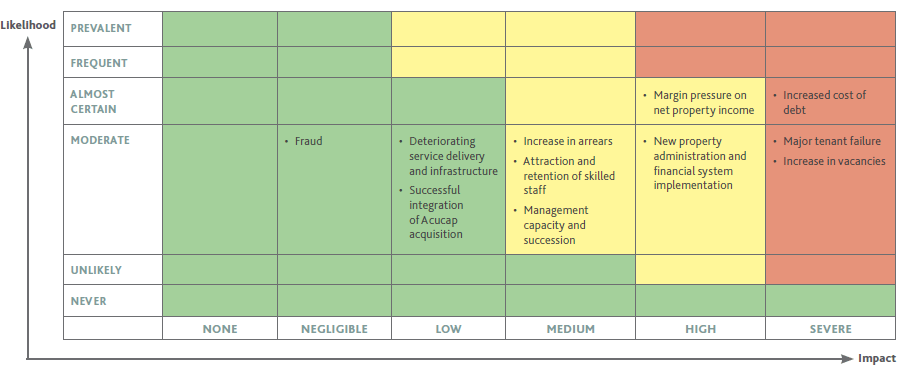
The key operational risks identified have been assessed in terms of their probability and their impact
on Growthpoint from both an inherent risk, as well as a residual risk perspective.
The inherent risk is the risk assessed prior to any response from management, whereas the residual
risk reflects the potential likelihood and impact of the risk after interventions taken by management.
The inherent and residual risks have been depicted in “heat maps” below.
| Key risk
identified |
Probable effects
of risk |
Inherent risk
assessment |
Response to risk |
Residual risk
assessment |
Key performance
indicator and
performance |
Find out
more |
| Major tenant
failure |
| • |
Large vacancies that
cannot readily be filled |
| • |
Unable to re-let retail
space due to the limited
pool of national retailers |
| • |
Additional costs incurred
in filling vacancies |
| • |
Re-letting of space which
is at a lower rental than
the current or market
rental |
|
Likelihood:
Almost certain
Impact:
Severe |
| • |
Tenant
creditworthiness
is assessed at the
inception of a lease |
| • |
Sector and
geographically
diverse portfolio of
properties |
|
Likelihood:
Moderate
Impact:
Severe |
RSA bad debts written
off less recoveries
R15,1 million
(FY14: R6,6 million) |
Page 88 |
| Increase in
vacancies |
| • |
Reduction in net property
income |
| • |
Additional costs incurred
in filling vacancies |
|
Likelihood:
Almost certain
Impact:
Severe |
| • |
Upgrading,
refurbishment and
enhancement of
properties |
| • |
Tenant incentives |
| • |
Broker incentives |
|
Likelihood:
Moderate
Impact:
Severe |
RSA vacancies
| • |
Retail: 3.3%
(FY14: 4.5%) |
| • |
Office: 8.0%
(FY14: 8.0%) |
| • |
Industrial: 5.3%
(FY14: 3.0%) |
|
Page 75 Page 82 Page 88 |
| Increase in arrears |
| • |
Significant monies owing
are irrecoverable |
| • |
Increase in working capital
requirements |
|
Likelihood:
Almost certain
Impact:
Medium |
Credit risk
management processes
implemented and
enforced |
Likelihood:
Moderate
Impact:
Medium |
RSA arrears as
a percentage of
collectables
| • |
Retail: 10.2%
(FY14: 9.3%) |
| • |
Office: 5.0%
(FY14: 3.5%) |
| • |
Industrial: 6.5%
(FY14: 3.8%) |
|
Page 75 Page 83
Page 88 |
| Deteriorating
service delivery
and infrastructure |
| • |
Loss of tenants to nodes
with better service levels/
working infrastructure |
| • |
The incurring of additional
expenditure to retain
tenants |
|
Likelihood:
Almost certain
Impact:
Medium |
| • |
Upgrading,
refurbishment and
enhancement of
properties |
| • |
Building sustainability
initiatives |
|
Likelihood:
Moderate
Impact:
Low |
Renewal percentage of
RSA leases
65.5%
(FY14: 65.7%) |
Page 75 Page 82 |
| Margin pressure
on net property
income |
|
Likelihood:
Prevalent
Impact:
High |
| • |
Annual budgets
are prepared and
approved |
| • |
Monitoring of
performance against
budget per building,
strategic business
unit, sector and
at RSA operations
(excluding the V&A
Waterfront) level |
|
Likelihood: Almost
certain
Impact:
High |
RSA property expense
ratio (excluding the
V&A)
24.0%
(FY14: 24.8%) |
Page 37 |
| New property
administration
and financial
system
implementation |
| • |
Not meeting the minimum
functional requirements of
the business |
| • |
Non-realisation of
envisaged efficiencies
resulting from the
introduction of new
processes |
|
Likelihood: Moderate
Impact:
Severe |
A Steering Committee
headed by the Chief
Information Officer
was initiated at the
inception of the
project and oversees
all project-related
activities. The Chief
Information Officer
reports on the project
at each Executive
Committee meeting |
Likelihood: Moderate
Impact:
High |
Project scorecard |
|
| Attraction and
retention of skilled
staff |
| • |
Operational instability
and/or lack of experience
resulting in poor service
levels |
| • |
Loss of credibility by
external stakeholders |
|
Likelihood: Almost certain
Impact:
High |
| • |
The Remuneration
Committee fixes
the remuneration
packages of
individual directors
and members of
senior management
with the objective
of attracting and
retaining people of
the required calibre |
| • |
A Staff Incentive
Scheme was
established so as to
assist in the retention
of personnel |
|
Likelihood:
Moderate
Impact:
Medium |
RSA retention of
personnel
Resignations (including
retirements) of only
11.6%
(FY14: 8.1%) of
employees |
Page 55 Page 58 |
| Successful
integration of
Acucap and Sycom
acquisition |
| • |
The loss of key Acucap and
Sycom personnel |
| • |
Disproportionate
allocation of personnel and
resources to integration
activities |
| • |
Slower than intended
realisation of synergies |
|
Likelihood: Almost certain
Impact:
High |
An Acucap Steering
Committee comprising
all members of the
Executive Committee,
as well as a number
of other role players,
including former
Acucap – now
Growthpoint
employees, meets on a
monthly basis to share
information with regard
to the integration
process and to discuss
matters that could
hinder the successful
integration of the
Acucap acquisition |
Likelihood:
Moderate
Impact:
Low |
| • |
Retention of key
Acucap personnel |
| • |
Property expense
ratio | Property expense
ratio
|
Page 36 Page 104 |
| Increased cost of
debt |
| • |
Volatility in distributions |
| • |
Breaching of interest
covenants |
| • |
Impacts the required
forward yield for the
acquisition of properties |
|
Likelihood: Prevalent
Impact: Severe |
Utilisation of interest
rate swap contracts
to ensure adherence
to RSA policy of
maintaining a minimum
rolling 12-month fixed
to floating ratio on
debt of 75% |
Likelihood: Almost
certain
Impact:
Severe |
RSA proportion of
fixed to floating
borrowings
76.0%
(FY14: 78.4%) |
Page 50 |
| Management
capacity and
succession |
| • |
Cannot readily react to
opportunities that arise in
the market place |
| • |
Loss of credibility by
external stakeholders |
| • |
Operational instability
and/or experience resulting
in poor service levels |
|
Likelihood: Almost certain
Impact:
High |
| • |
The Executive
Committee
meets monthly
to discuss and
address operational
performance and any
related matters of
concern |
| • |
Loss of credibility by
external stakeholders | The Remuneration
Committee reviews
the succession plan
of Exco
|
Likelihood: Moderate
Impact:
Medium |
Renewal percentage of
RSA leases
65.5%
(FY14: 65.7%) |
Page 39 |
| Fraud |
| • |
Lower distribution income |
| • |
Reputational damage |
|
Likelihood: Almost certain
Impact:
Medium
|
| • |
Growthpoint has
a crime and civil
liability insurance
policy which
addresses fraud by
both employees and
others, as well as
civil liability to third
parties |
| • |
Internal Audit
addresses all matters
identified through the
Tip-offs Anonymous
Helpline |
The Remuneration
Committee reviews
the succession plan
of Exco
|
Likelihood: Moderate
Impact:
Low |
RSA number and
extent of fraud claims
Nil
(FY14: Nil) |
Page 132 |